Ah, Horse Apples

Hi. Been a while.

Just performed with Horse Apples – Me, David, Nick, Matt, and Barry.

We want to keep doing this because it’s fun for us – we’re all dads and at least 40, so really this is the fun for us. But we’re very sensitive to holding up a space in a community we’re so glad to see growing. We want to deserve our spot, not just get to ride out our wake.

Solution 1Get the Young Hungrys to open the show. They’ll bring friends and family. An audience is often more family and friends than random entertainment seekers. Even in the bigger cities if you consider “students and hobbiests” who are “there to see their friends,” “there to see their friends.” Our families and friends are asleep in our/their children’s beds. The Young Hungrys’ friends and family would show up, not yet exhausted by either the invites or the improv.

Solution 2Cultivate Opener with TLC. Leveraging “The Lottery” approach, marry outstanding students with establishment players/teachers in a group committed to multiple rehearsals and shows. Barry coached. Casts have been great.

Solution 3Do better improv. Can’t coast. Gotta step up. We needed to rehearse. We needed coaching – one voice that could matter more than our opinions and align us. At The Second City, star players were going to First Cities for sitcoms they could think of you for. Think of times when you just laughed at something funny and those times you wanted the person eliciting laughter to know you were laughing so you laughed a little harder. Horse Apples are the guys who moved to Third City, Richmond VA, for family. No one in our audience is motivated to show up or laugh for us; we gotta make’em laugh.

Solution 4Gimmick? Tenure in improv is immaterial when a child is infinitely better at improvising than an adult. But, maybe one benefit of our beens-around-the-block is owning being a museum. We’ll fill a wheel with named improv formats written on each pie piece. An audience member would spin the wheel to determine our form for the night and give us our suggestion and the show would start.

Tonight we spun the wheel for the first time…

Continue reading

Active Listening & Collaboration

I’ve developed an Active Listening & Collaboration workshop that has proven engaging.

I’ve run this session for a ton of high school students and for multiple cohorts of college programs’ Entrepreneurs and Healthcare Execs in Training. I’ve run almost fifty sessions with accountants and insurance professionals. I’ve even run it in a communal house and with a fresh crop of McKinsey consultants – two very different experiences.

I just yesterday – thanks to my wife and her network – run one for Virginia’s Legal Aid Program.

It was awesome! (Oh, and donate to Legal Aid – they MATTER!)

What follows is my preamble to that session which I offer here as a little didactic on why we should care about Active Listening & Collaboration, and learning those skills and more through improvisation can make us, well, better people.

Continue reading

Why Don’t You – a look at improv “no-nos”

Beginning Improvisers are given a lot of rules about what not to do.

Don’t say “no.” Don’t ask questions. Don’t negate or negotiate imagined reality. Don’t do teaching or transaction scenes.

Why not?

Here’s a quick look at why improvisers are told to avoid these moves and how you can absolutely successfully do those moves.

Continue reading

Call & Response Connections

Dang, it’s been along time since I posted. There is a site re-design in the works and I have been working through teaching online. So lots of good things ahead for improvdoesbest.com.

But here it is Halloween night 2020. I’m feeling a little hopeful (knock on wood). And an interaction just inspired me to knock out this little post.

My daughter is digging into her bag of treats and said, “These gummies are delicious.”

“As a matter they are, she said,” I said.

My wife laughed.

Continue reading

Find “Game” by Feel

Mmmm…what do these have in common?

When asked for a desired focus for a scheduled coaching session, a Duo sent me the following:

Mainly character stuff, fleshing them out versus building out more plot. Getting better at finding and sticking to the game of the scene.

What follows is some didactic and exercises that filled two hours.

DIDACTIC: How do You think about “Game” in improv?

Acknowledged ad nauseam here on Improv As Improv Does Best, the idea of “Game” gets thrown around a lot in improv.

At its most dumbed down, “Game” is “the funny thing, done more.” Though what the “funny thing” is is subjective.

At once both more sophisticated and more corny, “Game” can focus on the repetition of the cause and effect of actions. Short Form‘s blessing and curse is that its rhythms connect so quickly (helped by being made explicit) – the audience is rigged to react to anticipation but the rigging can be too tight and become stale.

Aiming for an universal answer this site’s materials are predicated on the definition of “Game” as “a sequence of actions related by cause in effect, heightening in a progression through repetition.” Holds true for baseball and Monopoly alike.

Regardless of definition, “Game” needs Emotion.  Continue reading

Help Desk Cartoons

Building a game out of heightening the pattern of an interaction isn’t just for improv.

It’s a creation tool. At least if you’re looking to create something coherent.

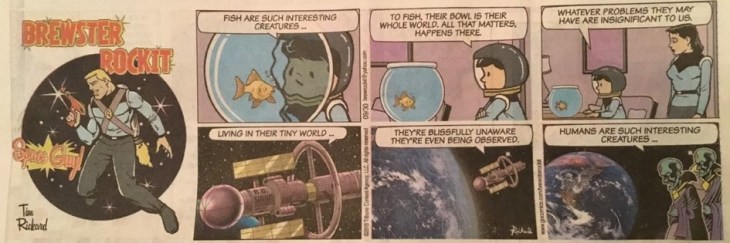
Both of these cartoons appeared in The Washington Post’s Sunday Cartoon section on September 30th. Read Jef Mallett’s Frazz and Tim Rickard’s Brewster Rockit below – but also just read them in general; they’re great.

Brewster Rocket Help Desk

Frazz Help Desk

How could they not remind me of our friend The Help Desk rubric group game?

In a Help Desk Game, the progression of the scenic games establishes the pattern, and that pattern’s evolving repetition serves to heighten a personal game or theme.

What’s just beautiful thinking about these comic strips as improv scenes using the Help Desk Dynamic, is how they get to call lights before they have to get to the punchline. By setting our expectations in the first interaction, WE – the reader or audience – laugh at following the second interaction in our own heads based on the first. Our Lizard Brain laughs at the recognition of the pattern – and that’s enough for your edit!

Patterns allow us to play confidently. Thanks for the illustrations, Jef and Tim!


Just Act Natural

Acting. Webster’s defines it as: the art or practice of representing a character on a stage or before cameras. Fine. You’re acting when you’re pretending to be someone else. Then what’s “good acting”? Representing that character better. What’s “bad acting”? Representing that character worse. How does that relate to improv where the character only exists in what we do and what the audience sees? What about the 4th wall – so prominent in improvisation – that calls attention to the actor and the audience?
I like this definition for acting: Being convincingly in-the-moment.

Continue reading